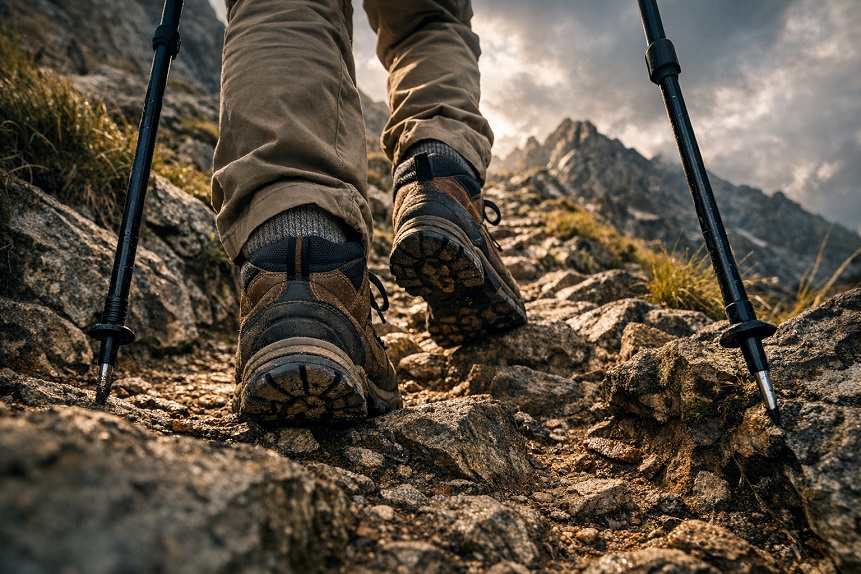
Ask any experienced hiker where they feel a long day on the trail most keenly, and the answer is almost always the same: the descent. The climb might leave the lungs complaining and the legs heavy, but it is the long downhill in the final hours that deposits its calling card in the knees, sometimes with interest. The burning quadriceps, the hesitant steps on uneven terrain, and the knees that announce their presence on the stairs for the next two days are experiences so universal among hikers that they have become accepted as simply part of the pursuit. They do not have to be.
Hiking is one of the most beneficial activities available for overall health, and its joint health profile is considerably more positive than its reputation for knee damage might suggest. But it does place specific, well-characterised mechanical demands on particular joints, and those demands are different enough from flat-surface activities that understanding them specifically is worthwhile for anyone who hikes regularly or aspires to longer, more demanding routes.
Here is the hiking-specific joint picture, where the real risks concentrate, and what a practical joint protection approach looks like for hikers at any level.
What Descending Does to Your Knees That Ascending Does Not
The asymmetry between ascending and descending in terms of joint stress is one of the most consistent findings in the biomechanics of hiking, and it explains why the descent is disproportionately responsible for the joint discomfort that follows a significant day on the trail. The mechanics are worth understanding because they point directly toward the interventions that help most.
Eccentric Quadriceps Loading on Descent
Descending a slope requires the quadriceps to work eccentrically: contracting while lengthening to control the rate of descent against gravity rather than producing the concentric shortening that drives ascent. Eccentric muscle loading generates more muscle damage and metabolic stress per unit of work than concentric loading, which is why descending is more fatiguing for the muscles and more damaging for the surrounding tissues than ascending equivalent elevation. The quadriceps’ eccentric work during descent transmits large compressive forces through the patellofemoral joint, with research documenting patellofemoral joint reaction forces during downhill walking that significantly exceed those of level walking at the same speed. For hikers with any degree of patellofemoral cartilage thinning, this is the loading environment that most directly stresses the joint.
Tibiofemoral Loading on Uneven Terrain
Hiking on uneven terrain demands that the knee absorb and redistribute forces in multiple planes simultaneously, unlike the largely sagittal-plane loading of flat walking or running. Lateral and rotational forces on the tibiofemoral joint from uneven footfalls, particularly when carrying a pack that shifts the centre of gravity, load the cartilage of the medial and lateral compartments in patterns that may concentrate stress on specific cartilage regions rather than distributing it evenly. The cumulative effect of many hours of uneven terrain, particularly on descent, is meaningful cartilage loading that benefits from the structural support of Glucosamine Sulfate 2KCL and Phytodroitin™ for ongoing matrix maintenance.
The Ankle: The Joint That Hiking Demands Most From
The ankle is the primary interface between the hiker and the terrain, and its role on uneven surfaces extends well beyond the simple hinge mechanics of flat-surface walking. On rocky, rooted, or cambered trail surfaces, the subtalar joint, the ankle complex’s secondary joint that controls inversion and eversion, is continuously adapting to the irregularity of the terrain, making micro-corrections that maintain balance and distribute ground reaction forces across the foot and upward through the lower extremity. This is demanding neurological and mechanical work that flat-surface activities simply do not replicate.
Ankle sprains are the most common hiking injuries, and they occur most predictably during descent on uneven terrain when fatigue has reduced the neuromuscular responsiveness needed to prevent excessive inversion before the ankle’s passive stabilisers are loaded beyond their limits. Previous ankle sprains that were not fully rehabilitated leave behind residual proprioceptive deficits and ligamentous laxity that significantly increase re-sprain risk. OptiMSM® supports the collagen synthesis of the ankle ligaments that bear these loads, and its antioxidant protection through glutathione synthesis is relevant to the oxidative stress that high-volume hiking accumulates in connective tissue. For hikers who have experienced previous ankle sprains, the ligament support dimension of OptiMSM® is particularly relevant to their joint health strategy.
The Hip and Lumbar Spine: What Pack Weight and Terrain Gradient Add
Day hikers carrying light packs experience different joint demands from multi-day trekkers carrying substantial loads over extended periods. A 15 kg backpack increases the compressive forces through the hip joints and lumbar spine during both ascent and descent by amounts proportional to the percentage increase in effective body weight, and on steep terrain with significant pack weight the cumulative loading on hip cartilage and lumbar facet joints across a full trekking day is substantial. Multi-day trekking that involves consecutive days of significant elevation change without recovery days compounds this accumulation in ways that can produce hip and lumbar discomfort that hikers with day-trip experience do not anticipate from their shorter outings.
The anti-inflammatory support of CurcuWIN® and AprèsFlex® is relevant to managing the inflammatory response that multi-day trekking loading accumulates in hip and lumbar joints, providing the pathway coverage to reduce the background inflammatory burden that sustained daily physical demands generate. Beginning a multi-day trekking trip with these anti-inflammatory ingredients already established in a daily supplementation routine, rather than attempting to start them on the trail, gives them time to reach effective tissue concentrations before the demanding loading begins.
Practical Joint Protection for Hikers: On and Off the Trail
The most impactful joint protection measures for hikers operate at several levels simultaneously, and the combination of smart equipment choices, technique on descent, and consistent nutritional support covers the major risk factors more completely than any single intervention alone.
Trekking poles significantly reduce knee loading on descent by transferring a proportion of the compressive and eccentric load to the upper body, and research has confirmed meaningful reductions in tibiofemoral and patellofemoral compressive forces with appropriate pole use. Well-fitted footwear that provides ankle support appropriate to the terrain reduces inversion sprain risk and distributes ground reaction forces more evenly through the foot. Slowing down on descent and using a slightly wider stance to reduce the per-step eccentric load is a technique modification that experienced hikers use instinctively and that novices benefit from explicitly adopting.
Off the trail, building the quadriceps strength that controls descent mechanics and the hip abductor strength that maintains lower extremity alignment on uneven ground is the most impactful preparatory exercise investment for hikers. The strength-to-bodyweight ratio of the quadriceps is a direct determinant of patellofemoral joint stress during descent: stronger quadriceps at the same body weight produce smaller cartilage contact forces for the same terrain gradient. Regular hiking preparation that includes eccentric quadriceps loading, such as slow step-downs and walking lunges, specifically prepares the muscles for the demands of descent in a way that general fitness training does not. For a broader view of the exercise strategies that protect joints across all activities, our article on exercises that support joint health provides the full framework.
Frequently Asked Questions
- Should hikers with knee osteoarthritis avoid hiking entirely?
- Blanket avoidance of hiking for people with knee osteoarthritis is rarely the right recommendation and often counterproductive, since the muscle weakness and weight gain that tend to follow activity avoidance worsen the joint health picture over time. Modifications including using trekking poles, avoiding very steep descents, keeping pack weight minimal, choosing flatter routes or shorter distances, and taking rest days between demanding hikes allow most people with moderate knee osteoarthritis to continue hiking safely. The appropriate level of modification depends on the severity of symptoms and the individual’s functional capacity, which is worth discussing with a physiotherapist or orthopaedic specialist for specific guidance.
- Do hiking boots actually protect joints, or is it mostly marketing?
- The evidence on hiking footwear and joint health is more nuanced than either strong boots advocates or minimalist proponents tend to acknowledge. Well-fitted boots with appropriate ankle height do reduce inversion sprain risk on technical terrain, which has genuine joint protection value. The evidence that cushioned boots meaningfully reduce compressive joint forces compared to lighter footwear on graded terrain is less clear, as ground reaction forces are largely determined by terrain gradient and descent speed rather than cushioning. Fit and suitability to the terrain are more important than any single feature, and waterproofing and traction are more reliably evidence-grounded benefits than impact reduction claims.
- How important is hydration for joint health during hiking?
- Adequate hydration is genuinely relevant to joint health during extended physical activity. Synovial fluid is water-based, and dehydration reduces the volume and viscosity of synovial fluid in ways that increase friction and reduce the efficiency of cartilage nutrition. The effect is most relevant during long, hot hikes where sweat loss is significant. Drinking to thirst, which research has generally supported as a reliable hydration guide for adults, is adequate for most hiking scenarios. Electrolyte replacement becomes relevant during very long or hot outings where sweat sodium losses are significant and plain water replacement alone can lead to hyponatraemia. Our article on hydration and joint health covers this relationship in more detail.
- Is it worth taking joint supplements specifically for a trekking holiday, or only if hiking regularly throughout the year?
- For people who hike irregularly but undertake occasional demanding treks, the structural joint support ingredients require weeks of consistent use before reaching the tissue concentrations associated with meaningful effect, which means starting supplementation specifically for a trekking holiday the week before departure provides minimal structural benefit. The anti-inflammatory ingredients, particularly AprèsFlex®, have faster onset and can be relevant for a specific demanding event with a few weeks of lead time. For anyone who hikes regularly throughout the year, year-round supplementation provides the stable connective tissue support that makes the occasional demanding trip less likely to produce the day-after joint consequences that many hikers accept as inevitable.
The knees and ankles that carry you up a mountain and safely back down are doing extraordinary work, and they deserve the support that makes that work sustainable for decades of trails ahead. The combination of smart technique, appropriate equipment, targeted strength preparation, and consistent nutritional support for the connective tissues doing the work is what separates hikers who continue to explore demanding terrain into their sixties and seventies from those who reluctantly limit themselves to gentler paths. The trail is worth protecting your joints for.