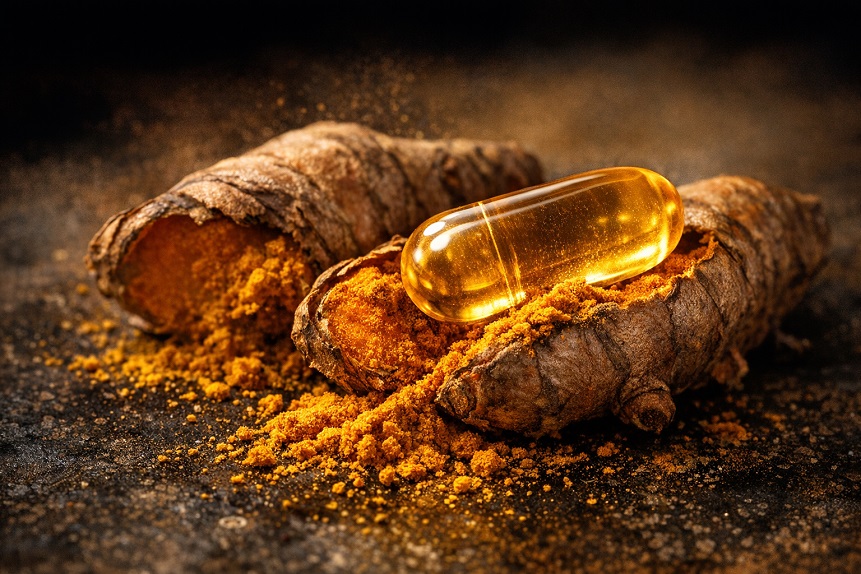
Turmeric has earned a genuine reputation as one of the most researched anti-inflammatory botanicals in existence. The research base is substantial, the mechanisms are well characterised, and the clinical evidence for its joint-relevant effects is more convincing than most people realise. There is just one persistent problem: getting enough of the active compounds out of a capsule and into your bloodstream to actually produce those effects.
Standard curcumin, the primary active compound in turmeric, is notoriously poorly absorbed from the digestive tract. The gap between what the research shows curcumin can do and what a standard turmeric supplement actually delivers is largely a bioavailability story, and it is a story that explains why so many people try turmeric capsules, notice little benefit, and conclude that the research must have been exaggerated.
CurcuWIN® is a specific, patented form of curcumin designed to address the absorption problem directly. Understanding what it does differently, and why that difference matters in practice, is the key to making sense of the curcumin market.
Why Standard Curcumin Has a Bioavailability Problem
Curcumin belongs to a class of plant compounds called polyphenols, many of which share a common challenge: they are poorly soluble in water, which limits how effectively they can be absorbed through the water-based environment of the digestive tract. The gut lining is designed to absorb nutrients dissolved in aqueous solution, and fat-soluble or water-insoluble compounds like curcumin struggle to cross it efficiently. Studies examining standard curcumin absorption have found that the vast majority of an oral dose passes through the digestive tract without being absorbed, eventually exiting the body via the same route it entered.
The First-Pass Metabolism Complication
Even the fraction of curcumin that does make it through the gut wall faces a second obstacle: rapid metabolism. Curcumin is extensively metabolised in the gut wall itself and in the liver, converting quickly into conjugated forms that have different biological activities from the parent curcumin molecule. This rapid first-pass metabolism means that even with improved gut absorption, maintaining meaningful circulating curcumin concentrations requires addressing the metabolic rate as well. It is a two-stage problem, and solutions that address only the absorption stage without considering metabolic fate are only doing half the job.
The Piperine Approach: Better But Limited
The most widely used strategy for improving curcumin bioavailability is adding piperine, the active compound in black pepper, which inhibits some of the enzymes responsible for rapid curcumin metabolism and modestly improves absorption. Piperine-containing curcumin formulations do outperform standard curcumin in bioavailability studies, typically showing two to twenty times greater absorption depending on the study. However, piperine also inhibits drug-metabolising enzymes more broadly, which creates potential interactions with medications metabolised by the same pathways. It is a blunt instrument applied to a precise problem, and the degree of improvement it provides, while real, remains well below what more sophisticated delivery technologies can achieve.
How CurcuWIN® Solves the Absorption Problem
CurcuWIN® uses a technology called UltraSOL, a water-dispersible delivery system that transforms the fat-soluble curcuminoid compounds into a form that disperses readily in aqueous solution. Rather than delivering curcumin as a crystalline powder that the gut struggles to dissolve, CurcuWIN® encapsulates curcuminoids in a matrix that makes them behave as though they are water-soluble, dramatically increasing the surface area available for absorption and the concentration gradient driving absorption across the gut wall.
The Bioavailability Advantage in Numbers
Clinical research comparing CurcuWIN® to standard curcumin extract has found significantly superior absorption, with some studies reporting curcuminoid concentrations in the bloodstream following CurcuWIN® supplementation that are approximately 46 times greater than those achieved with an equivalent dose of standard curcumin. This is not a marginal improvement. It represents the difference between a dose that reaches meaningful tissue concentrations and one that largely passes through without systemic effect. For practical purposes, it means that a lower milligram dose of CurcuWIN® can deliver more bioavailable curcuminoids than a much larger dose of standard turmeric extract, which has significant implications for both efficacy and formulation efficiency.
Full-Spectrum Curcuminoid Profile
CurcuWIN® delivers a full spectrum of curcuminoids from Curcuma longa rather than isolated curcumin alone. Turmeric contains three primary curcuminoids: curcumin, bisdemethoxycurcumin, and demethoxycurcumin, each with slightly different biological activities and anti-inflammatory mechanisms. Research suggests that the combination of all three curcuminoids produces more comprehensive effects than curcumin in isolation, and CurcuWIN® preserves this natural profile within its water-dispersible delivery system. This is a meaningful distinction from some curcumin products that standardise exclusively to curcumin content while discarding the other naturally occurring curcuminoids.
What Better Bioavailability Actually Means for Joint Health
The reason bioavailability matters for joint health specifically is that curcumin’s anti-inflammatory mechanisms operate at the cellular and molecular level within joint tissues, and reaching those tissues in meaningful concentrations is a prerequisite for producing those effects. Curcumin works primarily by modulating key inflammatory signalling pathways, including NF-kB, one of the master regulators of the body’s inflammatory response, and by inhibiting the enzymes COX-2 and LOX that drive the production of prostaglandins and leukotrienes, the inflammatory mediators responsible for joint pain and swelling.
In vitro research demonstrating these mechanisms is compelling, but in vitro conditions are very different from the challenge of delivering an effective concentration of curcumin to inflamed synovial tissue in a living human. The gap between compelling laboratory results and inconsistent clinical outcomes in many curcumin trials is precisely the bioavailability gap. Trials using highly bioavailable curcumin forms have consistently produced stronger and more reliable results than those using standard extracts, which is the most important context for evaluating the clinical evidence on curcumin for joint health.
For the broader context on how turmeric and curcuminoids fit into the joint inflammation story, our article on the science behind turmeric and curcuminoids for joint inflammation covers the mechanisms and clinical evidence in more depth. And to understand how CurcuWIN® works alongside the other ingredients in a comprehensive joint support formula, our analysis of the full joint support ingredient stack provides the complete picture.
Evaluating Curcumin Products: What to Look For on a Label
The curcumin supplement market is crowded, and the variation in product quality is substantial. When evaluating any curcumin product for joint health purposes, several things are worth checking beyond the milligram dose on the front of the label. First, the specific form of curcumin used: a product listing “turmeric extract” or “curcumin” without specifying a patented bioavailability technology is almost certainly delivering standard, poorly absorbed curcumin regardless of the dose. Second, the standardisation percentage: look for the curcuminoid content percentage rather than simply the weight of turmeric powder included. Third, whether the bioavailability claim is supported by human pharmacokinetic data rather than merely in vitro or animal research, which does not reliably predict human absorption outcomes.
CurcuWIN® is one of several patented bioavailability-enhanced curcumin technologies on the market, alongside others such as Meriva, BCM-95, and Longvida. Each uses a different delivery mechanism and has its own clinical data. The common thread between them is that they all significantly outperform standard curcumin in human absorption studies, which is the baseline requirement for any curcumin product that claims to deliver meaningful anti-inflammatory effects.
Frequently Asked Questions
- Is CurcuWIN® the same as standard turmeric powder?
- No. Standard turmeric powder, including standard turmeric extracts standardised to a percentage of curcumin, delivers curcuminoids in a form that is very poorly absorbed by the digestive tract. CurcuWIN® uses a patented UltraSOL water-dispersible delivery technology that dramatically increases curcuminoid absorption, with clinical research showing approximately 46-fold greater bioavailability than standard curcumin extract. The curcuminoids are sourced from the same Curcuma longa plant, but the delivery technology transforms how effectively they reach systemic circulation.
- Do I need to take CurcuWIN® with food?
- Unlike standard curcumin, which is typically recommended to be taken with fat-containing food to improve its fat-soluble absorption, CurcuWIN® uses a water-dispersible technology that makes it significantly less dependent on dietary fat for absorption. Taking it with meals remains a sensible practice for general tolerability, but the dramatic food-dependency that characterises standard curcumin absorption is substantially reduced with CurcuWIN® formulations.
- How long does CurcuWIN® take to produce effects on joint inflammation?
- Clinical studies on bioavailable curcumin forms for joint outcomes have generally observed meaningful improvements in joint comfort and mobility within four to eight weeks of consistent daily supplementation. Anti-inflammatory effects on molecular markers can be detected earlier, but the translation to subjective joint comfort improvements typically follows a four to six week timeline. Consistent daily use is more important than any individual dose, as curcumin’s anti-inflammatory effects accumulate with sustained supplementation.
- Can CurcuWIN® interact with medications?
- Curcumin at supplemental doses has a number of potential drug interactions worth being aware of. It may potentiate the effects of blood-thinning medications including warfarin and aspirin, and may interact with diabetes medications by influencing blood glucose. Unlike piperine-based curcumin formulations, CurcuWIN® does not use enzyme inhibitors that broadly affect drug metabolism, which reduces but does not eliminate interaction concerns. Anyone taking prescription medications should consult a healthcare professional before adding curcumin supplementation.
The bioavailability gap is the single most important thing to understand about curcumin supplementation, because it explains both why the research is so compelling and why so many people’s personal experience with turmeric capsules has been underwhelming. The compound works. Getting enough of it to where it needs to go is the challenge that patented technologies like CurcuWIN® exist to solve. If you are evaluating a joint supplement that lists curcumin among its ingredients, the form it uses is the first thing worth checking.