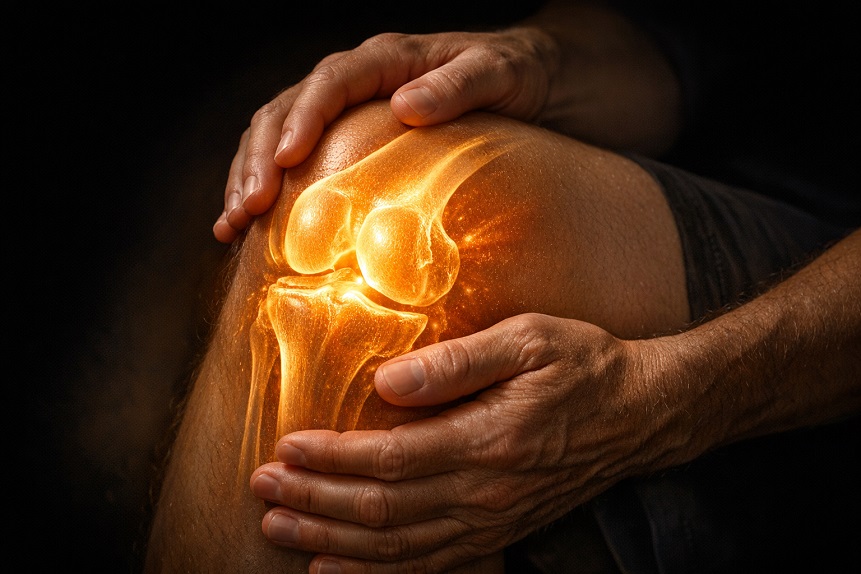
Joints rarely give up without notice. Before the persistent ache that sends people searching for answers, there is usually a period of quieter signals: small changes in how a joint feels after activity, subtle shifts in range of motion, sounds that were not there before. The problem is that these early signals are easy to rationalise away. You slept awkwardly. You overdid it at the gym. You are getting older, and this is just what that feels like.
Sometimes those explanations are accurate. But sometimes the quiet signals are the joint’s way of asking for attention before the situation becomes significantly harder to manage. The gap between “noticing and acting” and “ignoring and waiting” can span years, and those years matter enormously in terms of what cartilage and connective tissue health looks like on the other side.
Here are the early warning signs worth taking seriously, what each one likely means biologically, and what a thoughtful response to each one looks like.
Morning Stiffness That Takes More Than a Few Minutes to Clear
Some morning stiffness is entirely normal across most of adult life, particularly in synovial joints like knees, hips, and fingers. The question worth asking is how long it takes to resolve. Stiffness that clears within five to ten minutes of movement is generally consistent with normal joint fluid dynamics: the synovial fluid redistributing after a period of rest. Stiffness that persists for twenty to thirty minutes or longer before a joint feels comfortable and functional is a more meaningful signal.
Prolonged morning stiffness can indicate that the synovial fluid in that joint has changed in quality or volume, that the synovial membrane has some degree of inflammation, or that cartilage thinning has progressed enough to make the joint more sensitive to the overnight stasis that all joints experience. In inflammatory arthritis conditions like rheumatoid arthritis, morning stiffness lasting more than an hour is one of the diagnostic criteria. In the context of age-related joint changes and early osteoarthritis, morning stiffness of fifteen to thirty minutes that occurs consistently is worth addressing proactively rather than waiting for it to extend further.
The practical response is to start the day with gentle movement before loading the stiff joints significantly, and to consider whether your nutritional support for synovial fluid quality and cartilage maintenance is adequate. Our article on how synovial fluid works and what happens when you do not have enough is relevant background here.
Joint Sounds: Clicks, Pops, and Crepitus
The occasional pop when you stand up or the click when you bend a knee is not, in itself, a reason for alarm. Joints make sounds for several reasons, most of them benign: gas bubbles collapsing in synovial fluid, tendons briefly snapping over bony prominences, or the normal sounds of tissue sliding over tissue during movement. If the sounds come without pain and without any accompanying swelling or instability, they are generally not a clinical concern.
The signal worth paying attention to is crepitus: a grating, grinding, or crackling sensation or sound during movement that is different in character from the occasional pop. Crepitus often reflects roughening of cartilage surfaces, the loss of the smooth gliding surface that healthy cartilage provides. When you can feel or hear the roughness of two cartilage surfaces moving against each other, that is a meaningful indicator that cartilage quality in that joint has declined. It does not necessarily indicate severe damage, but it does indicate that the joint would benefit from support targeted at cartilage matrix integrity, including Glucosamine Sulfate 2KCL and Phytodroitin™, which provide structural building blocks for the proteoglycan matrix that gives cartilage its smooth surface.
Reduced Range of Motion That Was Not There Before
Most people have a fairly intuitive sense of how far a joint should comfortably move, even if they have never formally measured it. When a shoulder that used to reach easily overhead now catches uncomfortably at a certain angle, or a hip that used to allow easy cross-legged sitting now pulls against that position, or a knee that used to bend fully in a deep squat now stops short of where it used to go, these are meaningful signals of change in the joint or its surrounding soft tissues.
Reduced range of motion can originate in the joint itself, from cartilage changes or the formation of small bony spurs called osteophytes, or it can originate in the soft tissues around the joint: tightened joint capsule, thickened synovial membrane, or reduced flexibility in the tendons and ligaments that guide joint movement. Distinguishing between these requires professional assessment in cases where the restriction is significant or progressive. For mild, gradual reductions in range, regular movement through the full available range of motion, combined with appropriate flexibility work and connective tissue nutritional support, is the most sensible first response.
Swelling That Appears After Activity and Then Resolves
Mild swelling around a joint after strenuous activity, particularly early in a training programme or after an unusually demanding day, can be a normal response to the mechanical stress of that activity. Swelling that appears after activities that never caused it before, or that is disproportionate to the level of activity involved, is a more significant signal.
Post-activity joint swelling typically reflects increased production of synovial fluid in response to irritation of the synovial membrane. The membrane is producing more fluid than usual in response to joint stress, and the joint capsule, which has limited capacity to expand, becomes visibly swollen. Recurring episodes of this kind indicate that the joint is being irritated more easily than it once was, which can reflect cartilage thinning, early synovial inflammation, or the kind of cumulative loading discussed in our article on how repetitive motion damages joints over time. Swelling accompanied by warmth and redness is more likely to reflect active inflammation and warrants medical assessment sooner rather than later.
Stiffness or Discomfort After Sitting That Was Not Previously Present
The “gelling” phenomenon, where a joint that has been still for thirty minutes or more becomes stiff and temporarily uncomfortable on first movement, is one of the characteristic early features of osteoarthritic joint changes. Unlike morning stiffness, which follows many hours of stillness, gelling can occur after something as brief as a car journey or a cinema visit. If you find yourself standing up from a seat and needing a moment before your joints will cooperate with normal movement, and this was not your experience a year or two ago, it is worth noting as a signal.
The biology behind gelling mirrors that of morning stiffness: synovial fluid settling away from cartilage surfaces during rest and needing movement to redistribute. The fact that it now happens after shorter periods of stillness than it used to suggests that synovial fluid quality or volume has declined enough to make the joint more sensitive to even brief periods of inactivity. Addressing this means both optimising movement patterns throughout the day, avoiding prolonged static postures, and supporting the joint environment nutritionally with ingredients relevant to synovial membrane health and cartilage matrix maintenance.
Aching That Persists After Activity Has Ended
Some post-exercise joint awareness is normal and expected, particularly after unfamiliar or high-volume activity. The signal worth distinguishing is aching that persists well beyond the period when it should have resolved: joint discomfort that is still present the following morning after a workout that would not previously have left any residue, or that lingers through the rest of the day after a physically demanding shift at work.
Persistent post-activity aching suggests that the balance between joint loading and joint recovery has tipped in a way that is generating more inflammatory response than the joint can clear efficiently between sessions. This is an appropriate moment to consider both the loading side of the equation, reducing volume or intensity of the activities most clearly associated with the aching, and the recovery side, including nutritional support that addresses both the inflammatory signalling and the structural maintenance needs of the tissues involved. CurcuWIN® and AprèsFlex® Boswellia serrata extract are both relevant to managing the inflammatory component of this picture, while OptiMSM®, Glucosamine Sulfate 2KCL, and Phytodroitin™ support the structural maintenance side.
Recognising these early signals and responding to them proportionately is the most powerful form of joint health management available. The people who maintain the best joint health into their sixties, seventies, and beyond are rarely those who were blessed with exceptional genetics. They are more often the ones who paid attention to the early signals and made consistent, modest adjustments before the situation required dramatic intervention. Our guide to building a complete joint health routine is a practical next step if several of these signals are already familiar.
Frequently Asked Questions
- When should early joint warning signs prompt a visit to a doctor?
- Seek medical assessment promptly if a joint is visibly swollen and warm to the touch, if pain is severe or sudden in onset, if a joint feels unstable or gives way during normal activity, if symptoms are accompanied by systemic features like fever or unexplained weight loss, or if pain is present at rest and at night rather than only with activity. Gradual onset stiffness, mild crepitus, and modest reductions in range of motion are reasonable to address proactively through lifestyle and nutritional strategies before seeking medical input, provided they remain stable rather than rapidly worsening.
- Can early joint warning signs be reversed?
- Some can, and some represent changes that can be stabilised rather than reversed. Morning stiffness and gelling that stems from synovial fluid quality changes can often be improved through movement habits and nutritional support. Mild crepitus reflecting early cartilage surface roughening is unlikely to fully resolve, but its progression can be meaningfully slowed with appropriate support. The general principle is that early-stage changes respond much better to intervention than later-stage ones, which is precisely why recognising them early has such disproportionate value.
- Are these warning signs different for different joints?
- The underlying signals are broadly similar across joints, but where they appear and under what conditions varies. Knee joints tend to produce stiffness and crepitus most noticeably during stair climbing and squatting. Hip joint changes often show up as reduced rotation range and groin aching after activity. Shoulder changes are most apparent at the extreme ranges of overhead movement. Finger joint changes often show up as morning stiffness and swelling around the small joints. The joint or joints where you are noticing signals first is often a reflection of which joints have historically taken the most cumulative load in your specific life and activities.
- Is there a minimum age at which these warning signs should be taken seriously?
- There is no minimum age. Joint health warning signs in younger people are not less meaningful than those in older people: they simply reflect a different set of likely causes, often involving previous injury, occupational demands, genetic predisposition, or high training loads rather than the age-related changes more typical in people over 45. If these signals appear in your thirties or even your twenties, they warrant the same thoughtful response regardless of the fact that “you are too young for joint problems.” The biology does not check your birth certificate.
Your joints communicate in a language of sensations and signals that reward attention. Learning to interpret those signals accurately, rather than dismissing them or catastrophising them, is one of the most valuable habits you can develop for long-term physical wellbeing. If several of these warning signs are already part of your daily experience, our article on why joints change with age provides the biological context that makes sense of what you are feeling.