The phrase “natural anti-inflammatory” gets applied to an extraordinarily wide range of substances with an equally wide range of evidence behind them, from compounds with rigorous clinical trial support to ingredients whose anti-inflammatory claims rest on little more than traditional use and a persuasive marketing narrative. Sorting the evidence from the enthusiasm requires a consistent analytical framework: not “does this have anti-inflammatory properties?” (many things do under laboratory conditions), but “does this have anti-inflammatory effects that are large enough, specific enough, and well-enough absorbed to produce meaningful joint health outcomes in people?”
This guide applies that framework to the most researched botanical anti-inflammatories relevant to joint health, explains their specific mechanisms, and is honest about where the evidence is robust and where it trails off into promising-but-preliminary territory. The goal is a useful map rather than an enthusiastic inventory.
Tier One: Compounds With Strong Clinical Evidence for Joint Outcomes
A handful of botanical compounds have accumulated clinical evidence that goes beyond in vitro studies and animal models to include well-designed human trials with joint-specific outcomes. These are the compounds where the evidence is strong enough to make concrete recommendations rather than cautious suggestions.
Curcumin (Turmeric): The Most Researched Botanical Anti-Inflammatory
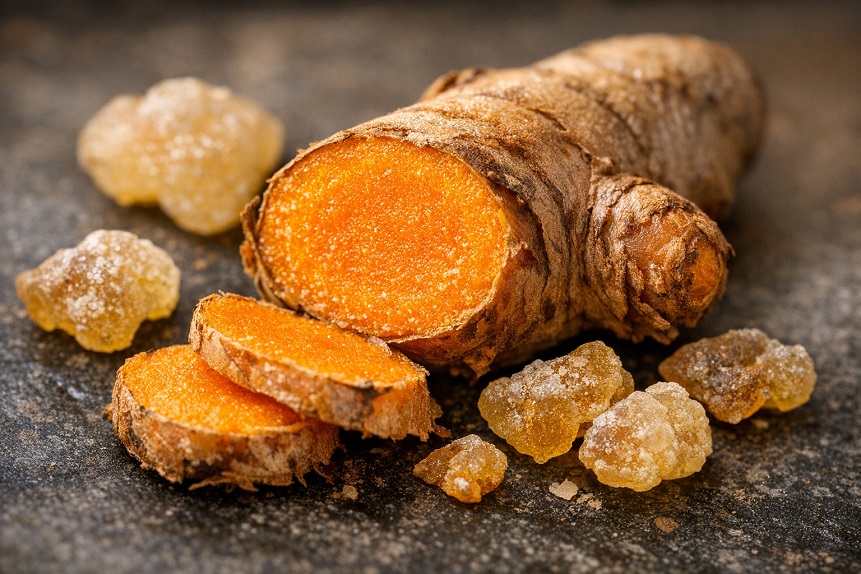
Curcumin, the primary active compound in Curcuma longa (turmeric), has the largest and most well-developed evidence base of any botanical anti-inflammatory compound for joint health applications. Its mechanisms are genuinely multi-pathway: NF-kB transcription factor inhibition (reducing the expression of multiple inflammatory genes simultaneously), COX-2 enzyme downregulation (reducing prostaglandin production), 5-LOX enzyme inhibition at high concentrations, MMP enzyme expression suppression (reducing cartilage-degrading enzyme activity), and direct chondrocyte-protective effects against inflammatory cytokine-induced apoptosis. This is not a single-mechanism compound: it intervenes at multiple points in the inflammatory cascade simultaneously, which is part of the reason its clinical results in joint conditions are consistent across different populations and trial designs.
The critical limitation, extensively covered elsewhere on this site, is bioavailability: standard curcumin extract is so poorly absorbed from the digestive tract that most of an oral dose reaches the colon unabsorbed. Bioavailability-enhanced forms including CurcuWIN® (UltraSOL technology), Meriva (phospholipid complexed), BCM-95 (turmeric essential oil), and Longvida (lipid nanoparticle) all dramatically improve absorption and are the forms used in the clinical trials with the most compelling results. The clinical evidence applies to these forms, not to standard turmeric powder or unenhanced curcumin extract. Dietary turmeric in cooking, while providing general health benefits from its full phytochemical profile, does not deliver curcuminoids at concentrations sufficient to replicate the effects seen in clinical research.
Boswellia serrata: The Complement to Curcumin
Boswellia serrata gum resin, specifically its most active fraction AKBA (acetyl-11-keto-beta-boswellic acid), provides anti-inflammatory mechanisms that curcumin addresses less effectively: selective 5-LOX enzyme inhibition and direct MMP-3 and MMP-13 inhibitory activity. The 5-LOX pathway produces leukotrienes, which are particularly implicated in the chronic low-grade synovial inflammation of osteoarthritis and in the cartilage-degrading enzymatic environment that drives progressive joint deterioration. Curcumin has some LOX pathway activity at high concentrations; AprèsFlex® Boswellia extract addresses this pathway more selectively and potently at lower doses.
The clinical research on AprèsFlex® specifically has documented meaningful reductions in joint discomfort within five days of starting supplementation, which is the fastest-onset clinical result available from any botanical joint compound. The combination of curcumin and boswellia therefore addresses the inflammatory cascade more comprehensively than either ingredient alone, with curcumin handling the COX and NF-kB dimensions and boswellia handling the 5-LOX and direct MMP dimensions, collectively providing broader anti-inflammatory pathway coverage than most pharmaceutical anti-inflammatory agents at equivalent joint tissue concentrations.
Tier Two: Compounds With Meaningful Evidence and Specific Applications
Several other botanical compounds have genuine anti-inflammatory evidence that supports their use in specific contexts, though their evidence base is less comprehensive or their application more limited than the tier one compounds.
Ginger (Zingiber officinale)
Ginger contains gingerols and shogaols, compounds with documented inhibitory effects on COX and LOX enzymes and on the production of pro-inflammatory cytokines. Clinical trials examining ginger supplementation for knee osteoarthritis have found modest but meaningful reductions in pain and stiffness scores compared to placebo. A systematic review of ginger for osteoarthritis found statistically significant effects on pain and disability, with a safety profile comparable to or better than NSAIDs. Ginger’s anti-inflammatory effects are weaker than those of curcumin or AKBA-enriched boswellia at the doses typically studied, but its excellent safety profile and ready dietary availability make it a useful complementary anti-inflammatory food and supplement ingredient. Culinary ginger use, particularly in liberal quantities in cooking, provides meaningful though modest anti-inflammatory input through a pathway that requires no additional supplementation effort.
Tart Cherry (Prunus cerasus)
Tart cherry, either as juice or concentrated extract, has accumulated clinical evidence that is particularly relevant to two specific joint health applications: gout (where its effects on uric acid metabolism and inflammatory response are the most consistently demonstrated dietary intervention available) and post-exercise joint inflammation in athletes. Multiple randomised trials have found that tart cherry consumption reduces circulating markers of exercise-induced inflammation and reports of muscle and joint soreness in the 24 to 48 hours following strenuous activity. The active compounds responsible for these effects include anthocyanins and other polyphenols that modulate inflammatory enzyme activity and cytokine production through mechanisms that partially overlap with those of curcumin. For athletes managing training-related joint inflammation, tart cherry is one of the most specifically evidence-supported dietary interventions available.
Resveratrol (Polygonum cuspidatum, grape skin)
Resveratrol, a polyphenol found in red grapes, red wine, and Japanese knotweed (Polygonum cuspidatum), has attracted substantial research interest for its multiple biological effects including NF-kB inhibition, SIRT1 activation, and modulation of inflammatory cytokine production. In the context of joint health specifically, resveratrol has been shown in cell and animal studies to inhibit the inflammatory pathways active in osteoarthritic chondrocytes and to reduce MMP enzyme activity. Human clinical evidence for joint outcomes is less extensive than for curcumin or boswellia, and the bioavailability of resveratrol from oral supplements is also limited (though somewhat less severely than standard curcumin). It is an ingredient with genuine mechanistic relevance and promising early clinical signals for joint health, positioned appropriately in a second tier until larger, better-designed human joint trials provide more definitive evidence.
Tier Three: Promising Compounds Where Evidence Is Early or Incomplete
A larger number of botanical compounds have anti-inflammatory properties supported by in vitro or animal research, traditional use, and preliminary human studies, but have not yet accumulated the clinical trial evidence base needed to make confident recommendations for joint health specifically. These include berberine (which has NF-kB inhibitory activity and has shown some clinical promise for metabolic-related inflammation, with limited joint-specific evidence), cat’s claw (Uncaria tomentosa, with COX and NF-kB inhibitory properties and some clinical evidence for osteoarthritis but studies are small and inconsistent), and pycnogenol (maritime pine bark extract, with documented anti-inflammatory effects and some clinical evidence for knee osteoarthritis pain reduction).
These compounds are interesting rather than established, and their tier three positioning reflects the honest state of the evidence rather than a judgment that they have no value. Some will accumulate clinical validation over the coming years that elevates them to higher tiers; others will not replicate their early promise in larger trials. Applying a tiered framework prevents both premature dismissal and premature adoption based on mechanism alone.
How to Combine Natural Anti-Inflammatories Effectively
The most evidence-grounded approach to using natural anti-inflammatory compounds for joint health is to prioritise tier one compounds (curcumin in bioavailability-enhanced form, AKBA-enriched boswellia extract) as the primary anti-inflammatory strategy, and to add tier two compounds (ginger, tart cherry) through diet where accessible and appropriate, rather than through supplementation of compounds whose individual evidence base does not yet justify the additional complexity and cost.
The combination of CurcuWIN® and AprèsFlex® provides the most comprehensively evidenced botanical anti-inflammatory stack available for joint health, addressing the COX, NF-kB, and 5-LOX pathways alongside direct MMP inhibitory effects. Adding dietary ginger and tart cherry provides complementary modest anti-inflammatory input through partially overlapping mechanisms without the cost and complexity of additional supplements. This layered approach, anchored in the strongest evidence and extended by dietary sources where practical, reflects how the evidence actually supports natural anti-inflammatory use rather than how the supplement market typically presents it.
For the full picture of how botanical anti-inflammatory compounds work alongside structural joint support ingredients in a complete formula, our complete ingredient stack analysis maps all the mechanisms together, and our comparison of curcumin and boswellia against NSAIDs addresses the most practically significant question for people currently using pharmaceutical anti-inflammatory management.
Frequently Asked Questions
- Are natural anti-inflammatories safer than NSAIDs for long-term use?
- The long-term safety profile of the tier one botanical anti-inflammatories (curcumin and boswellia) is substantially better than NSAIDs for the key risk domains: no gastrointestinal mucosal damage, no elevated cardiovascular risk from COX-2 inhibition, and no renal function concerns at supplemental doses. This safety advantage is one of the primary arguments for considering botanical alternatives for chronic joint pain management where ongoing daily anti-inflammatory support is needed. It is not an argument that natural compounds are universally safe: curcumin has drug interactions relevant for people on anticoagulants, and boswellia may modulate liver enzyme activity. Consulting a healthcare professional before making changes to anti-inflammatory management that includes prescription medications remains appropriate.
- Do natural anti-inflammatories work faster or slower than NSAIDs?
- NSAIDs produce rapid pain relief through direct enzyme inhibition: peak effects within one to two hours of an oral dose. Botanical anti-inflammatories generally produce effects more gradually, with AprèsFlex® being the fastest-acting at five days for meaningful clinical improvement. This onset difference means that botanical anti-inflammatories are less suitable for acute pain episodes where immediate relief is needed, and more appropriate for the ongoing management of chronic low-grade joint inflammation where the slower onset is acceptable relative to the superior long-term safety profile.
- Can I take multiple natural anti-inflammatory supplements simultaneously?
- Combining anti-inflammatory supplements that address different pathways makes pharmacological sense: curcumin and boswellia together provide broader pathway coverage than either alone, and adding dietary ginger or tart cherry adds modest complementary input through overlapping mechanisms. Combining multiple compounds that address the same pathway (such as multiple curcumin products simultaneously) is redundant and unlikely to produce proportionally greater benefit at higher combined doses. The guiding principle is mechanism complementarity: different pathways addressed by different compounds provides more comprehensive coverage than multiple products addressing the same pathway.
- Is there any evidence that natural anti-inflammatories modify the progression of osteoarthritis rather than just reducing symptoms?
- The evidence on structure modification from botanical compounds is less extensive than for symptomatic effects. AprèsFlex® Boswellia’s direct MMP inhibitory activity and curcumin’s MMP gene expression effects both represent potential cartilage-protective mechanisms that go beyond symptom suppression, but the long-term structure-modifying evidence from large randomised trials is much less developed than for glucosamine sulfate, which has the most established structure-modification evidence base in the supplement category. This is a meaningful distinction: symptom management and structural protection are both valuable, and the honest answer is that the botanical anti-inflammatory evidence is primarily symptomatic while the structure-modifying case remains mechanistically plausible but less definitively demonstrated.
The plant kingdom genuinely contains some of the most potent and best-characterised anti-inflammatory compounds available, and the top tier of them has clinical evidence that holds up to serious scrutiny. Navigating to the right compounds, in the right forms, at the right doses, and within a realistic understanding of what they can and cannot do requires the analytical framework that this article provides. The intersection of traditional medicine and modern pharmacognosy has produced something rare in health science: plant-derived compounds that are simultaneously well-characterised mechanistically, clinically validated, and genuinely safer for long-term use than the pharmaceutical alternatives they can meaningfully complement or in some contexts replace.