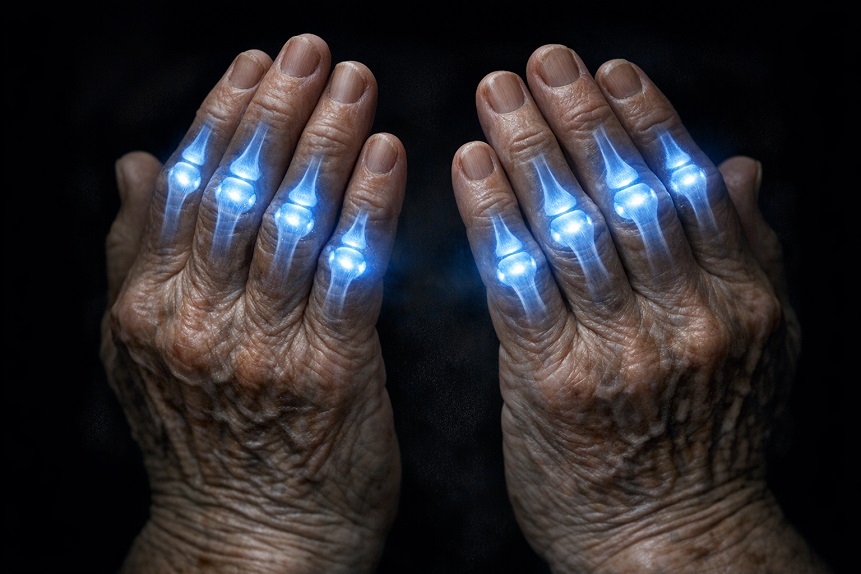
The idea that psychological stress worsens physical pain tends to be received with some scepticism, particularly by people whose joint pain is clearly structural in origin. “My cartilage is worn down,” the thinking goes. “What does stress have to do with that?” The answer is more specific and more biological than the slightly vague concept of mind-body connection might suggest, and it goes well beyond the idea that stressed people notice their pain more because they are less distracted. Psychological stress directly and measurably affects the biological environment in which joints operate, through pathways that are now well-enough characterised to be discussed in mechanistic rather than merely correlational terms.
This is not a chapter from a wellness retreat handbook. The cortisol-inflammation relationship and the central sensitisation of pain by psychological stressors are documented physiological phenomena with specific molecular mechanisms and specific clinical consequences for people managing chronic joint pain. Understanding them changes how a complete joint health strategy is assembled, because it reveals that a narrowly physical approach to a problem that has significant psychophysiological dimensions is inherently incomplete.
How Psychological Stress Reaches Joint Tissue
The pathway from psychological stressor to joint inflammation is not metaphorical. It is a well-characterised neuroendocrine cascade with specific molecular steps at each stage.
The HPA Axis and Cortisol: A Dual Role
When the brain perceives a stressor, whether physical or psychological, the hypothalamic-pituitary-adrenal (HPA) axis initiates the stress response: the hypothalamus releases corticotropin-releasing hormone (CRH), which stimulates the pituitary to release adrenocorticotropic hormone (ACTH), which drives the adrenal cortex to produce cortisol. Cortisol’s immediate role is broadly anti-inflammatory: it suppresses many immune functions to prioritise the acute fight-or-flight response. This is why short-term cortisol elevation, as in the acute stress response, tends to temporarily suppress rather than promote inflammation.
The chronic stress picture is fundamentally different and ultimately pro-inflammatory in its joint consequences. Persistent HPA axis activation from chronic psychological stress leads to glucocorticoid receptor resistance in immune cells: the immune system effectively becomes desensitised to cortisol’s anti-inflammatory signals and continues producing inflammatory cytokines despite elevated cortisol levels. This glucocorticoid resistance mechanism is one of the primary routes through which chronic psychological stress promotes rather than suppresses systemic inflammation, with directly measurable consequences in joint tissue. Research has confirmed that people with high chronic stress scores show elevated circulating inflammatory markers (CRP, IL-6, TNF-alpha) that are not explained by other lifestyle factors, and that these elevated markers correlate with both joint pain severity and joint disease progression rates.
The Sympathetic Nervous System and Synovial Inflammation
The sympathetic nervous system, activated during the stress response, directly innervates the synovial membrane of joints. Sympathetic nerve endings in synovial tissue release neuropeptides including substance P and neuropeptide Y that interact with synoviocyte receptors and directly modulate synovial membrane inflammatory activity. Research has found that substance P, released in increased quantities under sympathetic nervous system activation during stress, promotes the production of pro-inflammatory cytokines in synovial tissue and stimulates MMP enzyme activity that degrades cartilage. This is a direct neural pathway through which psychological stress reaches joint tissue without any need for a systemic inflammatory mediator to serve as the intermediary.
Pain Sensitisation: How Stress Amplifies Joint Pain Beyond Tissue Changes
Psychological stress and chronic pain have a relationship that operates not only through the biological joint environment but through the central nervous system’s processing of pain signals. Central sensitisation, the phenomenon by which chronic pain leads to amplified pain processing in the spinal cord and brain, is significantly influenced by psychological stress and negative affect states including anxiety and depression.
The Stress-Pain Amplification Mechanism
Under conditions of chronic psychological stress, the central pain-processing system undergoes neuroplastic changes that increase the sensitivity of pain signalling pathways. The descending pain inhibition systems (which normally modulate pain signals by applying a “braking” effect through serotonin and noradrenaline pathways) become less effective, while the ascending pain facilitation pathways become more active. The result is a pain system that is globally more sensitive: the same tissue-level stimulus (the same degree of cartilage stress, the same synovial inflammation) generates a stronger and more persistent pain experience than it would in a person without the same degree of chronic stress-driven central sensitisation.
This mechanism explains the clinical observation that joint pain severity does not always correlate with the degree of structural joint changes visible on imaging. Some people with significant osteoarthritis on MRI have minimal pain; others with relatively modest structural changes have severe pain. The difference is substantially explained by the degree of central sensitisation, which is itself substantially influenced by chronic psychological stress, sleep quality, anxiety, and depression, all of which are modifiable factors independent of the joint pathology itself.
Depression, Anxiety, and Joint Pain: A Bidirectional Relationship
Depression and anxiety are significantly more prevalent in people with chronic joint pain than in age-matched populations without joint conditions, and the relationship is genuinely bidirectional. Chronic pain is a well-established risk factor for developing depression and anxiety: it disrupts sleep, restricts activity and social participation, reduces independence, and creates a persistent unavoidable stressor that depletes the psychological resources available for mood regulation. Conversely, depression and anxiety worsen chronic pain outcomes through the central sensitisation mechanism described above, through reduced motivation for the physical activity that is among the most effective joint health interventions, and through the elevated inflammatory cytokine production that both conditions produce independently of any joint pathology.
The implication for joint health management is that psychological wellbeing is not a luxury addition to a joint health protocol: it is a genuine modifiable determinant of joint pain experience and inflammatory burden. People who address the psychological dimensions of their chronic joint pain alongside the physical dimensions consistently achieve better outcomes than those who pursue purely physical interventions, and the evidence base for psychological interventions in chronic pain (particularly cognitive behavioural therapy and mindfulness-based approaches) has reached a level of quality that places them in the same evidence tier as many physical interventions.
Practical Stress Management for Joint Health: What the Evidence Supports
Several stress management approaches have sufficient evidence for their effects on inflammatory markers and pain outcomes to warrant specific mention rather than the generic “reduce your stress” advice that is both obviously correct and practically useless.
Mindfulness-based stress reduction (MBSR) has been examined in multiple randomised trials for chronic pain conditions including osteoarthritis, with consistent findings of reduced pain intensity, improved physical function, and reductions in inflammatory biomarkers following eight-week programmes. The mechanism involves both the direct HPA axis regulation produced by mindfulness practice (reducing cortisol dysregulation) and the central pain system changes that mindfulness training produces over time. These are biological effects, not just attitude changes.
Regular aerobic exercise reduces cortisol dysregulation over time and is one of the most effective anti-depressant interventions available, which is relevant to the bidirectional stress-pain relationship described above. This is the same physical activity that benefits joint health through the mechanical and nutritional mechanisms discussed elsewhere on this site, making it an intervention that addresses multiple dimensions of the joint health problem simultaneously, which partly explains why its effects on joint outcomes are so consistently the largest of any single lifestyle intervention studied.
Adequate sleep, discussed in our article on how sleep affects joint recovery, is both a consequence of and a contributor to the stress-inflammation-pain cycle: poor sleep elevates stress response activity, reduces pain threshold, and promotes inflammatory burden, while good sleep actively resolves inflammatory mediators and restores pain threshold. Managing sleep quality is therefore simultaneously a stress management strategy and a direct joint health intervention.
The anti-inflammatory supplementation that constitutes the nutritional dimension of a joint health strategy provides a degree of counterbalance to the stress-driven inflammatory promotion described in this article, particularly the NF-kB pathway inhibition of CurcuWIN® and the 5-LOX pathway management of AprèsFlex®. These ingredients address the molecular consequences of stress-driven inflammation regardless of whether the psychological stressor causing the HPA axis activation has been resolved, which is why they have value as part of a comprehensive strategy that also includes stress management rather than as replacements for it.
Frequently Asked Questions
- Is joint pain ever “all in the head”?
- The question reflects a false dichotomy that the neuroscience of pain has largely resolved. Pain is always generated in the brain, which processes signals from the body’s tissues through a system that is modifiable by psychological states, past experiences, and expectation. This does not mean that people with significant joint pain are imagining it or that their tissue pathology is irrelevant. It means that the pain experience is the product of both peripheral tissue signals and central nervous system processing, and that both dimensions are real, both are biological, and both are modifiable. Dismissing chronic pain as psychological undermines appropriate management; ignoring the psychological dimension of chronic pain produces incomplete treatment responses.
- Can stress management alone reduce joint inflammation measurably?
- Yes, within limits. Research on mindfulness-based interventions and other stress reduction approaches has found measurable reductions in circulating inflammatory markers (particularly CRP and IL-6) following sustained practice. The magnitude of these reductions is meaningful but typically modest compared to targeted anti-inflammatory interventions. Stress management is most valuable as a complement to physical and nutritional joint health strategies rather than as a primary anti-inflammatory intervention, and its effects compound with those of other approaches rather than substituting for them.
- Should people with chronic joint pain seek psychological support?
- For people whose chronic joint pain is accompanied by significant mood disturbance, anxiety, sleep disruption, or functional limitation disproportionate to the structural findings, psychological support through a healthcare professional with expertise in chronic pain is a clinically appropriate component of the management plan. Cognitive behavioural therapy for chronic pain has a strong evidence base, and in some pain management programmes psychological intervention is considered as foundational as physical therapy. There is no stigma attached to this: the nervous system is a biological system that responds to biological interventions, of which psychological therapies are one category.
- Does a positive attitude help with joint pain recovery?
- Research on illness cognitions (how people think about their condition and their capacity to manage it) consistently finds that certain psychological orientations, including beliefs about the controllability of symptoms, the catastrophisation of pain experiences, and expectations about the future trajectory of the condition, predict outcomes independently of objective disease severity. People with higher pain catastrophisation scores experience more severe pain and worse functional outcomes from similar degrees of joint pathology than those with lower catastrophisation. Addressing these cognitive patterns through structured therapy produces measurable improvements in pain outcomes, which is more specific and evidence-grounded than the vague exhortation to “stay positive.”
The stress-cortisol-inflammation pathway is one of the most underappreciated elements of joint health management, because it sits at the intersection of disciplines that rarely speak to each other: rheumatology, pain neuroscience, and clinical psychology. The evidence that psychological stress directly promotes joint inflammation and amplifies pain through central sensitisation is specific and well-mechanised, and it implies that a joint health strategy that ignores the psychological environment is operating with a meaningful blind spot. The full picture of joint health, when assembled honestly, includes what you supplement, how you exercise, what you eat, how you sleep, how you move — and how you manage the chronic stressors that shape the neuroinflammatory environment in which all of the other interventions operate.