
The joint supplement category has a trust problem, and it has earned it. Millions of people have bought glucosamine products over the past two decades, taken them faithfully for a few weeks, noticed nothing, and concluded that joint supplements are either a scam or simply ineffective for them personally. A smaller number tried them for longer, still noticed little, and drew the same conclusion. The supplement industry’s response to this pattern has been to add more ingredients to labels rather than to address the actual reasons why the products were not working, which has produced a generation of increasingly complex joint formulas that are still failing the people buying them for the same underlying reasons they always were.
This article names those reasons specifically. Not as a generalised critique of the category, which contains some genuinely useful products, but as a specific diagnostic of the formulation failures that explain why so many joint supplements underperform relative to the research that nominally supports them. And it explains what a product needs to do differently to avoid those failures.
Formulation Problem One: The Wrong Form of Glucosamine
The most widespread and consequential formulation failure in the joint supplement category is the use of glucosamine hydrochloride in products whose evidence claims are based on research conducted with glucosamine sulfate. Glucosamine hydrochloride is cheaper to produce and contains a higher percentage of free glucosamine by weight than the sulfate form, which makes it attractive to manufacturers targeting a price point. What it does not provide is the sulfate component of glucosamine sulfate, which is itself biologically active in cartilage glycosaminoglycan sulphation rather than simply a carrier for the glucosamine molecule.
The clinical trial record reflects this difference clearly. The major American trial (GAIT) that found glucosamine largely ineffective used glucosamine hydrochloride. The major European trials that found meaningful symptomatic and structure-modifying benefits used glucosamine sulfate, specifically the 2KCL form. When consumers read that “glucosamine doesn’t work” based on the GAIT trial, they are reading a conclusion about glucosamine hydrochloride that has been inappropriately generalised to glucosamine sulfate. When they then purchase a product using glucosamine hydrochloride because it is what the pharmacy carries, they are replicating exactly the conditions of the trial that found the ingredient ineffective. The mismatch between evidence and product is not a coincidence: it is a systematic consequence of the category’s reluctance to use the more expensive form that the evidence actually supports.
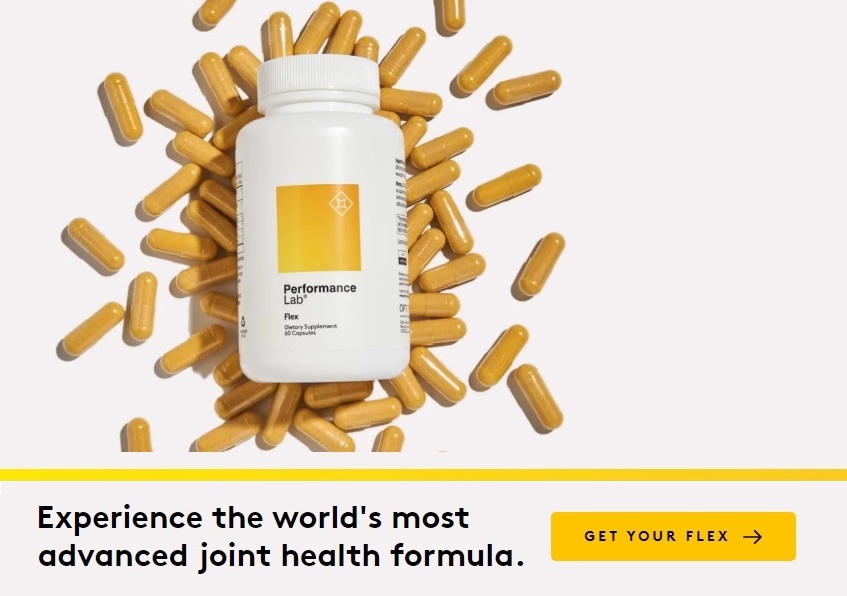
Performance Lab Flex uses Glucosamine Sulfate 2KCL specifically, the potassium chloride-stabilised form used in the European trials with the most compelling positive evidence, sourced from corn rather than shellfish to maintain vegan compatibility without compromising on the chemical form that the evidence requires. This is the single most important formulation decision in a joint supplement, and it is one that the majority of products on the market still get wrong.
Formulation Problem Two: Generic Curcumin That Cannot Be Absorbed
Turmeric and curcumin have become the most aggressively marketed botanical ingredients in the joint supplement category, on the back of a research base that is genuinely compelling. The research, however, was conducted with specific, bioavailability-enhanced curcumin preparations that achieve circulating concentrations dramatically higher than standard curcumin extract at equivalent oral doses. When products market turmeric or curcumin inclusion without specifying a bioavailability technology, they are citing evidence generated with a fundamentally different ingredient than the one they are including.
Standard curcumin is so poorly absorbed from the digestive tract that most of an oral dose passes through without reaching systemic circulation in meaningful quantities. A product that includes 500 mg of standard curcumin extract is providing a milligram dose that appears clinically relevant on the label while delivering circulating curcuminoid concentrations that may be a fraction of what is needed to replicate the anti-inflammatory effects documented in research. This is not merely a quantitative difference: it is the difference between an ingredient that can plausibly produce the effects claimed for it and one that cannot.
CurcuWIN® addresses this through a patented UltraSOL water-dispersible delivery technology that achieves approximately 46 times greater curcuminoid bioavailability than standard curcumin extract. This number is not a marketing claim: it comes from pharmacokinetic studies comparing plasma curcuminoid concentrations following equivalent oral doses of the two forms. Including CurcuWIN® at 62.5 mg provides more bioavailable curcuminoid than including standard curcumin at several times that dose. This is what “better absorbed” means in practice, and it is the difference between a curcumin inclusion that can contribute the documented anti-inflammatory effects and one that is decorating a label.
Formulation Problem Three: Generic Boswellia With Minimal AKBA
Boswellia serrata has the same problem as curcumin: the research evidence is compelling, and the products on the market are frequently unable to replicate it because they are using forms of the ingredient that do not deliver the specific compound the research was conducted with. AKBA (acetyl-11-keto-beta-boswellic acid) is the primary driver of boswellia’s most significant anti-inflammatory and cartilage-protective effects, and it typically represents only 1 to 3 percent of the total boswellic acid content in standard boswellia extracts. Products that standardise to “65 percent boswellic acids” and then cite research conducted with AKBA-enriched preparations are citing evidence they have not earned with their formulation.
AprèsFlex® is enriched to approximately 20 percent AKBA, a concentration that delivers substantially more of the active compound than generic extracts at equivalent milligram doses, and it uses a bioavailability-enhancing preparation that addresses AKBA’s inherent absorption limitations. The difference between AprèsFlex® at 100 mg and a generic “boswellia extract 100 mg” standardised to 65 percent boswellic acids is not a branding difference: it is a functional difference that determines whether the ingredient can produce the 5-LOX inhibitory and MMP-inhibitory effects that the clinical evidence attributes to it.
Formulation Problem Four: Proprietary Blends That Hide Inadequate Dosing
The proprietary blend is the joint supplement industry’s most reliable indicator of a formula that cannot bear scrutiny. When a label lists five, eight, or ten joint health ingredients within a single “proprietary blend” without disclosing individual amounts, the fundamental problem is arithmetic: fitting meaningful clinical doses of multiple ingredients into a blend that totals a few hundred milligrams is impossible. Glucosamine alone at a researched effective dose of 1,500 mg occupies more milligrams than many “comprehensive” joint blend totals. Any product listing glucosamine within a 500 mg proprietary blend is either including glucosamine at a dose so far below clinical relevance as to be meaningless, or omitting other ingredients to make the label look more impressive than the formula justifies.
Performance Lab Flex discloses every ingredient dose on the label with no proprietary blend. The ingredient amounts are: CurcuWIN® 62.5 mg, AprèsFlex® 100 mg, Glucosamine Sulfate 2KCL 750 mg per serving (with 1,500 mg achievable at the full daily dose), Phytodroitin™ 150 mg, and OptiMSM® 800 mg. These are disclosed, specific amounts that can be checked against the clinical research for each ingredient. Transparency of this kind is the minimum standard a supplement should meet, and it is remarkable how few products in the category actually achieve it.
Formulation Problem Five: Addressing Only One Dimension of Joint Health
The final and most conceptually significant formulation problem in most joint supplements is the failure to address joint health as a two-dimensional problem requiring both structural support and inflammatory management. The conventional market has historically built joint supplements almost entirely around structural ingredients: glucosamine and chondroitin, sometimes MSM. These address the cartilage maintenance dimension but leave the inflammatory environment that simultaneously drives symptom production and accelerates cartilage degradation entirely unaddressed.
The consequences are predictable: structural-only joint supplements produce modest benefits in people with mild early-stage joint changes and minimal active inflammation, and produce limited or no benefit in people with moderate to significant active joint inflammation, which is the majority of the people buying them. The people who most need anti-inflammatory support as a component of their joint health approach are the ones most likely to have tried a structural-only product, experienced little improvement, and concluded that joint supplementation does not work for them. This is the core of the category’s trust problem, and it is a formulation problem rather than an evidence problem.
A formula that combines structural support (Glucosamine Sulfate 2KCL and Phytodroitin™ for cartilage matrix, OptiMSM® for collagen synthesis) with anti-inflammatory management (CurcuWIN® for the COX and NF-kB pathways, AprèsFlex® for the 5-LOX pathway) addresses both dimensions. The result is a formula that works for a broader range of people across a wider range of joint health presentations than structural-only approaches, not because it contains more ingredients, but because the ingredients it contains address different and complementary aspects of the problem. Our complete ingredient stack analysis maps all five ingredients against the biological requirements of joint health in detail, and our full Performance Lab Flex review applies this framework to the specific product.
Frequently Asked Questions
- If most joint supplements have these problems, why do so many people seem satisfied with them?
- Several factors explain satisfaction with products that may not be delivering optimal clinical benefit. The placebo effect in subjective pain measures is substantial: improvement in joint discomfort that accompanies taking any supplement is partly genuine pharmacological effect and partly expectation-driven. Some people respond to suboptimal ingredients simply because individual biological variation means that even poorly absorbed curcumin reaches clinically relevant concentrations in some absorbers. And the natural fluctuation of joint symptoms means that some people start supplements during a symptom peak and experience improvement as the condition naturally cycles toward a better period, attributing the improvement to the supplement regardless of its actual contribution.
- Are any mainstream pharmacy joint supplements actually good?
- A small number of mainstream joint products make formulation decisions that partially address the problems described here. Osteo Bi-Flex Triple Strength includes 5-LOXIN®, a legitimate AKBA-enriched boswellia form. Some products correctly use glucosamine sulfate rather than hydrochloride. The issues are more rarely a complete absence of any quality decisions than an incomplete application of them, with most mainstream products getting some things right and others wrong. The analytical framework in this article allows readers to evaluate any product on its specific formulation decisions rather than its marketing positioning.
- How can a consumer verify the specific ingredient forms used in a supplement?
- Patented ingredient forms are identified by their registered trade names on labels: CurcuWIN®, AprèsFlex®, OptiMSM®, 5-LOXIN®, Meriva, BCM-95, and similar designations are all specific, verifiable ingredient forms with associated research. Generic ingredients without a trade name designation are using unspecified sourcing and manufacturing standards. Consumers can search for any trademarked ingredient name to find the manufacturer’s clinical evidence and specifications. The presence of trade name ingredients on a label is the most reliable single signal of formulation quality in the supplement industry, because it indicates that the manufacturer has made specific sourcing decisions that can be verified rather than using the most available or cheapest generic option.
- Does price reliably indicate quality in joint supplements?
- Price and quality correlate imperfectly in the supplement market. Premium ingredient forms do cost more, and some of that cost is reflected in product pricing. However, some premium-priced products use impressive packaging and branding to command prices that their generic ingredient formulations do not justify. The most reliable quality indicator is not price but the specific presence or absence of the formulation quality markers described in this article: disclosed dosages, named patented ingredient forms, and the inclusion of both structural and anti-inflammatory mechanisms. A mid-priced product meeting these criteria represents better value than a premium-priced product that does not.
The five formulation problems described here are not obscure technical issues: they are the specific, identifiable reasons why the joint supplement category has underdelivered for decades. Understanding them transforms how you read a supplement label, because you know exactly what to look for and what its absence means. The category is not beyond redemption, and the products that avoid these failures do exist. Knowing how to find them is what distinguishes informed supplement purchases from expensive guesswork.